 | |
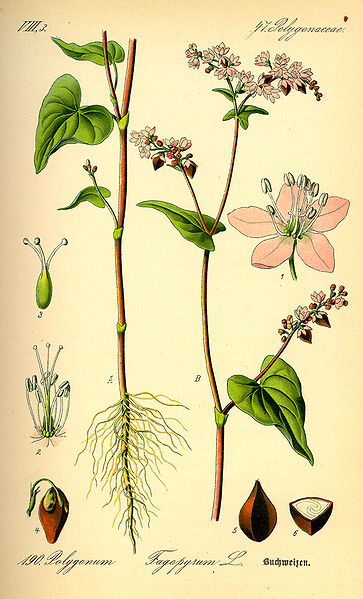
| Line drawing of Common Buckwheat from wikipedia. Note the fruit in the lower right. |

Showing posts with label fruit types. Show all posts
Showing posts with label fruit types. Show all posts
Thursday, February 2, 2012
and finally, the indehiscent fruits

Monday, January 30, 2012
dehiscent fruits
As I mentioned earlier, there are a few more types of dry fruits... I'm going to go into nine in total. Not all at once though, since we break this larger group up a little bit based one whether the fruits are dehiscent or indehiscent (again, based on whether or not they break open to release the seeds)
Ok, it's actually possible that I didn't take that photo. It was clearly taken in the North End at the Greenway, but I don't remember taking it, and it is dated 2009 which is before I really started taking photos there. Then again I do like milkweeds so it might have been me. If it wasn't me, it was almost certainly Tom Smarr who took it.
Regardless, I think this photo is ideal for getting a feel as to what a dry fruit is and how it differs from a wet fruit. Think back to the diagrams of the wet fruits: you can clearly see the pericarp (comprised of the exo, meso, and endocarp) is much thinner on the milkweed, most noteably lacking that characteristic layer of fleshy mesocarp we saw in all the wet fruits. Though the pericarp still covers and contains the seeds in a dry fruit, it is not attached to them nor does it hold them in place, leaving the seeds to freely disperse as soon as the fruit opens.
If you're not quite seeing the difference yet, contrast in your mind a banana and a peanut. If you cut a banana in half, the seeds still for the most part remain in the banana, stuck in and attached to that layer of fleshy mesocarp. On the other hand, if you split a peanut shell, the two seeds (peanuts) will fall right out. there's nothing there to hold them to the shell. Banana's a wet fruit, the peanut shell is a dry fruit.
The Milkweed and Peanut are both examples of simple dry fruits. Simple, in this case, means the fruit is the result of only one ovary maturing, and that two or more have not combined to form an aggregate fruit.
The Milkweed fruit is a follicle, a simple dry fruit that splits down one side to release the seeds. The peanut is a legume, a simple dry fruit that splits along both sides when releasing the seeds.
Now. though you probably believe me that the peanut fruit splits down both sides, you might be scratching your head as to why I'm saying the milkweed fruit splits down one side, since the photo of the follicle above clearly shows it apparently split in at least two places. Remember though, that this distinction is made when the fruit first opens, and in the photo above, the follicle had probably been present on the plant for quite a while. I'll try to get a photo that better shows this at some point (and not just because I feel bad for maybe stealing Tom's), but for now you'll have to take my word for it... well, I'll back it up with a story.
Back when I first started working at the Arnold Arboretum after finishing my undergrad, I had collected a few of these follicles (well, back then I knew them as "seed pods") off milkweeds as they were ripening, with hopes to do something with them later I guess (it was a flawed plan). I put these follicles in my locker where I apparently planned to leave them indefinitley (again, flawed plan). About two weeks passed, and I suddenly noticed one of the follicles had looked like it burst. It had just sort of popped, like an overstuffed suitcase that wasn't properly latched shut. Now is when the flaws in my plan should have become evident. The follicles were beginning to burst open to disperse their seeds, and one can easily tell by looking at the seed that the dispersal mechanism is "wind". All they needed was a source... like for example every time I opened or shut my locker door.
It took a good two to three months for the dispersal situation to die down enough for me to feel confident I could carry those follicles to the trash without making a bigger mess in the process.
Moral of the story: milkweed fruits split down one side. Keep them in a bag.
Moving on, there are also two dehiscent fruits resulting from multiple carpels: the capsule, and the silique. Now these are considered simple fruits as well, since even though more than one carpal is involved, the carpels have not fused together tightly enough to produce a true aggregate fruit such as a pineapple or strawberry.
A silique is characteristic of the mustard family, a long fruit resulting from two carpels. The individual seeds are held in that central portion until both sides of the fruit split off, allowing their release.
Last but most common, is the capsule. It is also the result of multiple carpels, but in this case those that were fused together in the a flower as a compound ovary.
The capsule will sometimes split in half to release seeds, though sometimes it actually bursts at the top. Since capsules are a bit more common, there are a few different dispersal mechanisms, so the distinction here isn't quite as important as it was when differentiating the follicle from the legume. What's important to remember is that it forms from more than one carpel, since the flower proceeding it possessed a compound ovary.
So that's it for deshicent fruits. In summary: If it's from one carpal and splits down one side, it's a follicle, if both sides, it's a legume. If it's from a compound ovary, it's a capsule, and if it's a long fruit of a mustard resulting from two carpels, it's a silique.
Don't worry too much though if you're having a little trouble with this... My guess is that you're feeling you'd have trouble looking at a fruit and guessing how many carpels the flower that proceeded it had. I wish I had a few good cross-section photos of capsules vs. follicles to show which might make it easier, but for now I'll say the capsule will usually look a little more "full" on the inside than the more empty milkweed pod we started the entry with. Regardless, my main hope here is to have us gain an appreciation for these different types of fruits. We can work out the details later.
Next time I'll cover the indehiscent fruits, and will have a photo that is indisputably mine.
 |
| Asclepias (Milkweed), a dry fruit, opening to release seeds |
Regardless, I think this photo is ideal for getting a feel as to what a dry fruit is and how it differs from a wet fruit. Think back to the diagrams of the wet fruits: you can clearly see the pericarp (comprised of the exo, meso, and endocarp) is much thinner on the milkweed, most noteably lacking that characteristic layer of fleshy mesocarp we saw in all the wet fruits. Though the pericarp still covers and contains the seeds in a dry fruit, it is not attached to them nor does it hold them in place, leaving the seeds to freely disperse as soon as the fruit opens.
 |
| The peanut, a legume. Taken from Wikipedia's Peanut entry as I have no peanuts in the house. .. and even if I did there would be no shells. Pericarp just gets in the way. |
The Milkweed and Peanut are both examples of simple dry fruits. Simple, in this case, means the fruit is the result of only one ovary maturing, and that two or more have not combined to form an aggregate fruit.
The Milkweed fruit is a follicle, a simple dry fruit that splits down one side to release the seeds. The peanut is a legume, a simple dry fruit that splits along both sides when releasing the seeds.
Now. though you probably believe me that the peanut fruit splits down both sides, you might be scratching your head as to why I'm saying the milkweed fruit splits down one side, since the photo of the follicle above clearly shows it apparently split in at least two places. Remember though, that this distinction is made when the fruit first opens, and in the photo above, the follicle had probably been present on the plant for quite a while. I'll try to get a photo that better shows this at some point (and not just because I feel bad for maybe stealing Tom's), but for now you'll have to take my word for it... well, I'll back it up with a story.
Back when I first started working at the Arnold Arboretum after finishing my undergrad, I had collected a few of these follicles (well, back then I knew them as "seed pods") off milkweeds as they were ripening, with hopes to do something with them later I guess (it was a flawed plan). I put these follicles in my locker where I apparently planned to leave them indefinitley (again, flawed plan). About two weeks passed, and I suddenly noticed one of the follicles had looked like it burst. It had just sort of popped, like an overstuffed suitcase that wasn't properly latched shut. Now is when the flaws in my plan should have become evident. The follicles were beginning to burst open to disperse their seeds, and one can easily tell by looking at the seed that the dispersal mechanism is "wind". All they needed was a source... like for example every time I opened or shut my locker door.
It took a good two to three months for the dispersal situation to die down enough for me to feel confident I could carry those follicles to the trash without making a bigger mess in the process.
Moral of the story: milkweed fruits split down one side. Keep them in a bag.
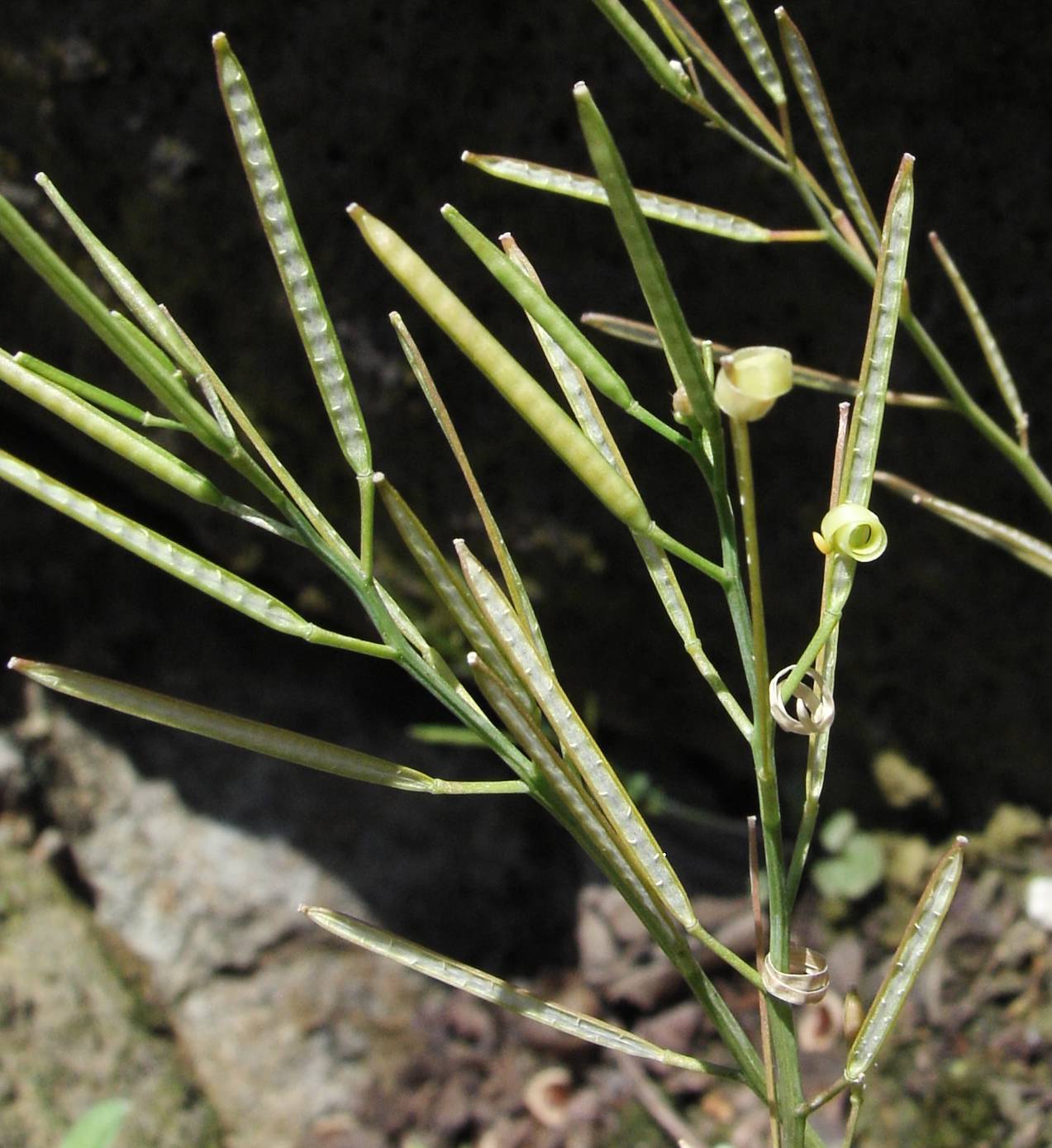 |
| From Wikipedia's entry on the silique |
Moving on, there are also two dehiscent fruits resulting from multiple carpels: the capsule, and the silique. Now these are considered simple fruits as well, since even though more than one carpal is involved, the carpels have not fused together tightly enough to produce a true aggregate fruit such as a pineapple or strawberry.
A silique is characteristic of the mustard family, a long fruit resulting from two carpels. The individual seeds are held in that central portion until both sides of the fruit split off, allowing their release.
Last but most common, is the capsule. It is also the result of multiple carpels, but in this case those that were fused together in the a flower as a compound ovary.
 |
| The Poppy, displaying a compound ovary. We can make out theanthers to the outside, but the female part of the flower is a far cry from the distinct stigma/style of the Amaryllis. From Wikipedia entry on the Poppy |
 |
| And from the same entry, the capsule ready to burst. |
So that's it for deshicent fruits. In summary: If it's from one carpal and splits down one side, it's a follicle, if both sides, it's a legume. If it's from a compound ovary, it's a capsule, and if it's a long fruit of a mustard resulting from two carpels, it's a silique.
Don't worry too much though if you're having a little trouble with this... My guess is that you're feeling you'd have trouble looking at a fruit and guessing how many carpels the flower that proceeded it had. I wish I had a few good cross-section photos of capsules vs. follicles to show which might make it easier, but for now I'll say the capsule will usually look a little more "full" on the inside than the more empty milkweed pod we started the entry with. Regardless, my main hope here is to have us gain an appreciation for these different types of fruits. We can work out the details later.
Next time I'll cover the indehiscent fruits, and will have a photo that is indisputably mine.
Monday, January 23, 2012
Pome fruits and plant families
So as promised, the next few entries are going to walk through the major categories of fruits. Now I'm not doing this just because I might run out of winter-interest plants to talk about at the rate I'm going, but mainly because I think that aside from people who tend a garden or care for houseplants; culinary fruits, nuts, and seeds might be the part of the plant most familiar.
Though terms like drupe can be a bit esoteric, you're already aware of what makes a peach different from an orange. Even though you might not think to describe the orange as a berry or the peach as a drupe, being able to notice these differences and knowing what to look for, in my mind, is more important than the specific vocabulary. I think this will be an easy way to show that you know more than you think you do, as well as a good way to start gaining an appreciation for the way a botanist hones in on certain characteristics to determine what makes certain plants more similar to each other.
So we already know that a drupe is a fruit with one single pitted seed (peaches) and a berry is one with multiple seeds (blueberry, banana, etc), now for the third type of wet fruit; the pome.
 |
| Not really sure why I bought this... not a big golden delicious fan |
Pomes have multiple seeds, but unlike the berry, the seeds aren't just hanging out wherever. They're kept in a "case" at the center of the fruit. You guessed it, the "core" we know from apples. Though the core (endocarp) isn't quite as stony as you'd find in the pit of a drupe, it is noticeable more solid than the fruit (mesocarp) surrounding it
 |
| Nicely labeled diagram from Wikipedia's entry on the Pome |
So now we know our wet fruits. Take a fruit and cut it open. If there's a single seed in a pit, it's a drupe. If there are multiple seeds confined in a core, it's a pome, and there are multiple seeds scatted throughout, it's a berry.
Easy, right? Leaves us plenty of time to go into something else I find interesting about the pome: the fact that despite how familiar they are to us (apples are usually the first fruit that comes to my mind anyway), they're actually somewhat uncommon in nature, or at least far less so than the drupe or berry. Only plants in the Rose Family produce them, and even then, not all of the genera in that family do.
Family? Genera? I think it's time for a brief review of the phylogenetic tree (or the "tree of life")
Now as you may remember from high school bio, the major divisions we use to categorize a living thing are (from most to least broad)... Kingdom, Phylum, Class, Order, Family, Genus, and Species (my bio teacher passed down the acronym "Kings play checkers on fuzzy green squares" as a mnemonic device)
I've already been using genera and species in this blog, any time I list a scientific name. For example, the Red Oak, or Quercus rubra: rubra, the species, means "red", and Quercus the genus, is the term for "oak".
As for the other levels, the only one we need to worry about right now is the family, that next level up which starts to group some of these different genera together (sticking with our Red Oaks example; Oaks, Beeches, and Chestnuts all make up the Beech Family). As for kingdom, all I'm probably going to talk about here are plants (unless I start taking photos of mushrooms or something), so we can pretty much forget about that. and we'll save the rest of the levels for later when I talk about a pine tree or something.
So apples are actually in the Rose Family, meaning the trees producing the apples we like to eat are pretty closely related to the shrubs and vines producing the roses we like to look at. This comes as a surprise to some, since as a society, we generally place a big distinction between ornamental plants and culinary plants. However, the way the plant is used is not how it is botanically categorized: most of classical taxonomy is done by floral characteristics, so the fact that both the apple tree and the shrub rose have a flower with typically five petals and stamens is more important than whether it produces a fruit we find appetizing.
I don't have any close-up photos of apple blossoms though (closest thing I found on my HD was a long shot of a flowering pear), so you'll have to take my word for it.
So we now know all of our "wet" fruit types, as well as some of the groupings that Taxonomists use to lump plants together. Next time we'll start going into the dry fruits. There are a few more, but once again I think you'll find many of them are already familiar to you.
Further Reading
Well in this case, it's viewing as. the Khan Academy has a great video about Taxonomy and the Tree of Life in case you're looking for a little more depth on that.
Also, did you ever wonder what the numbered code of the sticker on an apple (or any produce for that matter) stood for? I never paid much attention to it myself until I started using self-checkouts at the supermarket, but there is actually a difference in how the fruit has been raised depending on whether you see a four or five digit code.
A four digit code tells you the plant was grown using normal methods (so pesticides and all that), whereas a five digit code can mean one of two things. If the code starts with a 9, it was raised organically (no pesticides). If the code starts with an 8, the plant was genetically modified.
I don't think I've ever seen an 8 (or a 9 for that matter since I rarely buy organic produce), but I'll keep an eye out for either next time I'm at the Pathmark.
Saturday, January 21, 2012
Ilex verticillata, berries, and the definition of a cultivar
 |
| Ilex verticillata 'Winter Red' (Winterberry) |
This shrub should be quite a bit more recognizable, as it is quite common both in cultivation, as well as in the wild where it particularly stands out this time of year. Native to the wetlands of the Eastern and Central United States, as well as a similar range in Canada. It generally reaches 6-10' in height with a similar spread.
The characteristic berries actually appear in late summer, but persist well into winter. I'm not sure as to exactly how long the berries remain on the plants, but I've found birds generally pick these clean by the time the spring plants start putting on their show.
In terms of color, shape, and timing, some might pick up on these as looking similar to berries from the evergreen Holly Tree. The winterberry is actually in the same genus as hollies (Ilex) so obviously shares some of its characteristics. Primarily, the fact that these winterberries are dioecious, meaning each shrub is either male or female, but not both. Therefore, in order to get a fruit set at all, one needs to have both a male and at least one female plant (though generally most gardeners will have at least 3-4 females). The male plant will not produce berries, so the general convention is to hide the male behind the females.
 | ||||||||
| Crushed winterberry. Note the multiple seeds |
Until I started paying attention to such things, I would generally refer to larger fruits such as oranges as "fruits", and smaller ones such as blueberries as "berries"
It's not the size of the fruit that botanists use to make this distinction, but the number of seeds it contains. Some of the largest fruits we see in the produce isle, such as the grapefruit (Citrus x paradisi) and watermelon (Citrullus lanatus), are defined as berries due to having multiple seeds, where even the smallest cherries are considered drupes due to having one solitary pitted seed.
So next time someone acts all smug by bringing up the fact that tomatoes are fruits and not vegetables, you can smile to yourself secure with the fact that you know more, as the tomato is a berry.
Alright, now for a bit of horticultural terminology: I threw around the term "cultivar" a few times in the entry on Prunus mume, which though second nature to those of us in the horticultural field, is not exactly standard vernacular. It's a fairly easy concept though. I'll walk you through it.
We've defined Winterberry above as a shrub possessing red berries. But say you have quite a few of these on your property, and one day as they all produce fruit, you discover a freak of nature which looks like this:
 |
| Ilex verticillata 'Winter Gold' |
Plants, like any other form of life, have a certain amount of variability to them, be it leaf shape, flower size, resistance to a certain pest. or in this case, fruit color. As a result of sexual reproduction between two plants, a mutant occurred which has a dark yellow or golden berry as opposed to the traditional red.
Now being a plant enthusiast, this excites you and you can't wait to share your new plant with all your friends. You give them all a few of your prized golden berries and they begin growing new plants from their seeds. However, a few years later, when the offspring produces fruit of its own, only a scant few of them produce these golden berries, the majority of them reverting back to the standard red. And most disappointingly, about half didn't even produce berries at all.
So where did we go wrong? By choosing to hand out berries, and having our friends grow these plants from seed, we distributed plants which had our golden winterberry as the female parent but with an unspecified male. Sexual reproduction took place, so the seeds we handed out do not have identical DNA to our parent, golden-fruited plant. The 50% that didn't fruit are probably male offspring, and the female offspring which produced red berries likely did so as a result of genes from the male parent.
In order to distribute identical plants, we need to produce clones of our golden-fruited winterberry. For shrubs, this is typically done by taking cuttings. Tips of some of these branches would be removed, then the cut end dipped in a plant growth regulator such as Indoleacetic Acid (an Auxin). These cuttings are then stuck into a medium and kept in a high humidity environment, where the hormone will stimulate the cut ends of these twigs into producing roots. Usually 4-6 weeks later, the roots have grown to a significant enough size for the cuttings to be transplanted into a pot where they can continue to grow until big enough to be planted. If you give these to your friends, they'll all be female, and will all produce gold berries.

One step remains, we need a name for our plant, especially if we're proud enough of it we want to try to get local nurseries to distribute it further. In the case of this golden-fruited winterberry, the introducers chose the name "Winter Gold". The golden-fruited winterberry is a cultivar (which I believe to be shorthand for "cultivated variety"), and Winter Gold is the name of this cultivar. When using this as a part of the botanic name, Ilex verticillata, "Winter Gold" follows it in single quotes but not italicized, making the correct botanic name of this plant Ilex verticillata 'Winter Gold'
Another common (though now outdated) convention is to write the name as Ilex verticillata Cv. Winter Gold. You may see this occasionally on old botanic garden labels, or those produced with a label maker which cannot handle punctuation.
At the end of the day, I think I prefer the bright red of the straight species to the duller gold of this particular cultivar, but a little variety is always nice and a few plantings of these can help to break up the monotony where winterberry is used heavily.
Unlike Prunus mume, this plant is ubiquitous in cultivation, particularly in native-themed gardens, and a wide variety of cultivars are readily available in any nursery. The three I am most familar with are 'Winter Red' and 'Winter Gold', pictured above, and 'Red Sprite'. Winter Red and Gold are both taller forms of the species, reaching 7-9' at maturity whereas Red Sprite is smaller, reaching only 3-5'. Most Ilex species can tolerate fairly heavy pruning however, so it should be fairly easy to keep this plant to an appropriate size without fear of harming it too much. Note that for fruiting though, you will still need a male plant, of which a few cultivars exist. 'Southern Gentleman' is typically sold as a pollinator for the taller cultivars, whereas 'Jim Dandy' is more similar in height to 'Red Sprite' and the smaller cultivars, so often sold alongside them.
First snow of the year today here in Delaware, though it's predicted to soon turn to freezing rain. Might be able to get a few neat photos of these winter-interest plants with snow as a backdrop while doing some work for the botanic garden tomorrow.
Friday, January 20, 2012
Prunus mume and an introduction to fruit types
 | |
| Prunus mume (Plum Flower, Japanese Apricot) |
Prunus mume (mume pronounced like moo-may), is a tree
originally native to Japan and China reaching an adult height of 15-30’. Commonly
called the Japanese Apricot or Plum Flower, it is a member of the genus Prunus, which contains several species
of fruit trees including peaches, cherries, plums, apricots, and even almonds.
I find the inclusion of almonds in this group is often a
source of confusion for the less botanically-inclined. Why would a nut
be lumped in with all these fruit trees? In fact all of these trees
produce fruits which are considered “drupes”, a fruit type where a single seed
is surrounded by usually a fleshy layer fruit. The peach is often a textbook
example: think of it as comprising of three parts: the fuzzy “skin” of the peach
(exocarp) covering the fleshy fruit (mesocarp) which in turn encases the pit or
seed of the peach (the rough uneven outermost layer of the pit is the endocarp).
Almonds are drupes as well, however in
this case it is the seed we find edible rather than the mesocarp . The mesocarp
and green leathery exocarp of the almond fruit have already removed by the time
they reach the store, leaving only the endocarp and embryo. The shelled almonds
have their endocarp removed, whereas the unshelled still have the endocarp
remaining.
 | |||
| Diagram of a Peach Fruit (drupe) pulled from Wikipedia's entry |
An example of a “true nut”, botanically speaking, would be
something like an acorn or hazelnut, which is produced on the plant with a hardened
wall around the seed and no fleshy fruit layer. I’m now thinking of doing an
introduction to the major fruit types in a later entry, but for now let’s use
peaches and plums as our reference points for drupes.
Despite that we now know the plant produces a drupe, Prunus mume, is not generally known as a
fruit tree. Most of the plums you’ve eaten are probably members of Prunus x domestica, a name referring to
hybrids of two mainly European species. Prunus
mume is instead an ornamental grown for its flowers.
I remember seeing a few of these trees last summer upon moving
to Delaware, and have been keeping an eye on them since hoping to catch
a specimen in bloom. I first became interested in the species when doing a write-up
for the Greenway’s Chrysanthemum festival back in Fall 2010. I was trying to
find a brief tidbit from Chinese Folklore about the significance of the mum
flower to liven up the article a bit and came across a mention of the “Four Men
of Honor.” I’m not sure of all the details, but apparently these are a group of
plants traditionally believed to possess admirable human traits. The
Chrysanthemum symbolizes modesty, Bamboo represents integrity, the Orchid
stands for leisure, and finally, the Plum Blossom is seen as displaying
braveness.
 |
| The brave Plum Blossom! This is actually from the cultivar 'Pendula', though you'd never be able to tell without seeing the habit. Note that there are clearly five petals per flower, indicative of plants in the rose family. |
We already had bamboo and obviously chrysanthemums in the
Chinatown Park, so I thought it would be fun to add the remaining two men of
honor. Orchids are a huge family of plants so there were several options there,
but I was pushing for Bletilla striata,
the Chinese Ground Orchid, which in retrospect may have been a bit too fragile
for use in an urban park unless protected in a raised bed or container. The plum flower on the other hand was much
harder to track down. It’s thought of being only marginally hardy to New
England as it apparently has difficulty surviving the colder winters. Though I
think it would have been at least worth a shot given a protected location, many
of the New England Nurseries simply do not have the plant. I assumed that this
was due to the aforementioned hardiness issues, but its rarity appears to be
nationwide. It is however, decidedly more popular in Japan, with hundreds of
named cultivars.

I’m not sure if I see the evident braveness in this flower,
but there’s definitely something ballsy about coming into full bloom in
January. I’m the kind of person who likes being able to walk through a garden
at any point of the year and see something in bloom. The offerings for
December, January, and the first few weeks of February are understandably quite
sparse. Now granted we’ve had what I understand to be a very mild winter in
Delaware, at least so far, but when in late January I see a flowering tree that
approximates the flowering cherries so representative of spring, I can’t help
but feel that season is rapidly approaching, even if I know there are still
quite a few cold weeks ahead of us. I’m surprised, but also a bit disappointed this
plant is only rarely cultivated here in the US, and will certainly be keeping
an eye on it in the future, watching for any particular forms which may be
worthy of further evaluation.
 |
| We also have Prunus mume 'Hokkai' at the UDBG, which seems to be a semi-double form with darker flowers |
Edible Plums and Apricots
Subscribe to:
Posts (Atom)