Though spring is rapidly approaching, with snowdrops and some of the earliest daffodils and crocuses already appearing (as well as flowering cherries and magnolias in some places), the canopy still looks noticeable sparse as our deciduous trees have yet to show signs of leafing out, the only green up high provided by either broadleaf evergreens such as the American Holly (
Ilex opaca), or the needles of conifers such as the pines.
The evergreen nature, as well as their distinct needles make members of the Pine Family (Pinaceae) one of the easiest groups of trees for the less botanically inclined to identify: Pines have needles, other trees have leaves. The strength of this distinction holds well in plant taxonomy, as it is actually made at the phylum (or division) level, which as you remember is the second category after kingdom: this is indicative of the fact that Conifers and deciduous trees took a different evolutionary path quite a long time ago, with deciduous trees and other flowering plants or
angiosperms branching off from the conifers sometime in the Cretaceous Period 65,000,000 to 145,000,000 years ago.
Regardless, needles are considered to be the leaves of the pine: they photosynthesize and have similar anatomy, they're simply round instead of flat, and have a tendency to stay on the tree for more than one year (2-5 is probably a good range). They also usually have a thick waxy cuticle that leaves of most deciduous trees lack.
Pines are distinguished from their relatives such as Spruces, Firs, and Hemlocks in that they have needles borne on the stem of a plant in groups of two or more in a structure called a
fascicle, as opposed to being borne singly.
 |
| Small grove of Eastern White Pines (Pinus strobus) at the University of Delaware |
 |
| Cone of Pinus strobus |
The
Eastern White Pine (Pinus strobus) can easily be distinguished from the other pines listed here as they have five needles per fascicle as opposed to two or three. The needles are also a good deal thinner, less prickly to the touch, and give the tree in general a much softer appearance, even when viewed from a distance. The tree usually reaches a height of 50-80 feet in height, and can also grow quite quickly, sometimes upwards of two feet a year. It is unfortunately very intolerant of pollution, making it quite difficult to grow in urban settings.
 |
| Pinus palustris (Longelaf Pine) |
Longleaf Pine (Pinus palustris) is a more southern species, and quite easily identifiable due to the sheer length of its needles: they can approach upwards of a foot. There are some other pines which get as long or even longer, but in tropical, not temperate areas. The terminal bud on the stem is also a good ID characteristic, being large and white, though probably unnecessary given how distinct the leaves are.
The growth habit of Longleaf Pine is also somewhat interesting: for the first seven years of its life, it looks more or less like a grass, barely reaching a foot in height. It is however in the process of developing a root system, and once established, it rapidly increases in height, usually getting to about 60' but in some cases well over 100'. This growth habit actually makes the Longleaf Pine an undesirable plant for foresters, as the amount of time it spends in the "grass stage" makes it rather economically nonviable in terms of wood production.
 |
| Close up of the needles of Pinus palustris. Almost wish I had my hand in the frame for size comparison, but regardless, you'll know this species when you see it. |
 |
| And in colder weather... |
The next three pines are a bit less distinct:
Pitch Pine (Pinus rigida),
Pond Pine (Pinus serotina), and
Loblolly Pine (Pinus taeda) all have either two or three needles per fascicle (usually three). If you're in New England however, you're unlikely to see the latter two species as they don't really start appearing in the wild until you get to New Jersey and points south.
 |
| A young Pitch Pine (Pinus rigida) at my parents' house in West Tisbury, MA |
 |
Pinus rigida as a bonsai, seen
at the Philadelphia Flower Show |
Pitch Pine (Pinus rigida) was one of the first trees I learned how to identify. When at summer camp one year (I cant remember if it or Sassafras came first), I remember the counselor talking about the three needles per bundle (I doubt the term "fascicle" was used), saying we could remember that since in baseball they throw pitches, and three strikes is an out. The only other pines I remember seeing on the Vineyard were
Red Pine (Pinus resinosa) which only has two needles per fascicle, and
Eastern White Pine (Pinus strobus), which as we already know has five, though maybe there were a few other two-needle pines as well. I'll have to ask about it next time I'm down there (well, actually "up" there now that I've moved to Delaware).
Pitch Pine is quite ubiquitous on the vineyard, especially around my parents house right now as most of the oaks have died following repeated attacks by the Forest Tent Caterpillar. opw the Pitch Pines have the sun they need and are rapidly taking over the property. I'm all for it personally but haven't been able to convince my dad to let them live: they're one of his most hated trees, and probably justifiably so as I seem to recall him needing to cut a rather mature specimen down right next to the house which had its own established Yellow Jacket population associated with it. Still, though the species is probably not the most ornamental of pines, it does do quite well in poor soils so it at leasts has its place in the wild.
 |
| Loblolly Pine (Pinus taeda) |
Loblolly Pine (Pinus taeda) resembles Pitch Pine to a certain extent, though it does have a tendency to get a bit taller (upwards of 90' where Pitch Pine usually, but not always, maxes out around 60'), and as noted about Loblolly Pine isn't generally found in the wild up north. Most notably however, the needles of Loblolly Pine are a bit longer: between 6-10" as opposed to Pitch Pine's 3-5".
What Loblolly Pine really resembles, in both range and needle length is Pond Pine
(Pinus serotina). There are two easy ways to tell them apart however. First, the cones of Loblolly Pine are quite a bit longer and more extended. Since cones are not always present however, you can also look at the terminal bud on the stem. In Pond Pine, the bud will be white and covered in resin, whereas in Loblolly Pine, it is not and is red in color.
The word "Loblolly", according to dictionary.com anyway, apparently refers to a mud pit with the consistency of porridge. Who knew?
 |
| Shorter and rounder cones of Pond Pine (Pinus serotina) |
 |
| Longer cones of Loblolly Pine (Pinus taeda) |
 |
| White, resin covered bud of Pond Pine (Pinus serotina) |
 |
Redder terminal bud of Loblolly Pine (Pinus taeda), you want to look at the structure on
the end of the stem: try not to be distracted by the developing male cones underneath. |
 |
| Pond Pine (Pinus serotina) |
Not much more to say about
Pond Pine (Pinus serotina). It's a close relative of Pitch Pine with a more southern range. It also tends to inhabit a wetter habitat, as it's common name would suggest, generally found in areas with wet, poorly drained soils. Such as in the proximity of pines.
Out of the five pines discussed here, only one of them, Eastern White Pine, is really popular as a landscape plant. Though Pitch, Pond, and Loblolly Pine probably aren't the most ornamental and interesting of trees, I find it surprising that Longleaf Pine isn't more popular due to the needle length. I suspect that the same production issues which bar it from use in timber production may be to blame, with nurserymen perhaps unwilling to dedicate greenhouse space to a plant which won't be of a decent size until almost seven years. Still, I think it's a neat pine I'll be keeping an eye out for in the future.
Not really sure what to talk about next... waiting on some of the Maple and Oak ID posts until I can get some leaf photos. I want to talk a little bit about algae but need to read up on that first, but I do have a few photos of trees with interesting bark it might be fun to discuss as well...


 Up in New England, its much more common to see the Sweetbay Magnolia (Magnolia virginiana) in the landscape, though there is one wild population known in Massachusetts. It's considered to be "Semi-evergreen", as many leaves will often remain on the plant through the winter months. I've seen this vary immensely from tree to tree. The vast majority of plants I witnessed in New England would have few if any leaves present on the tree by February, probably 5% leaf cover at maximum, though there was one plant in Boston I remember being surprised to still have something like 75% cover even after a cold winter. When I moved to Delaware, as expected many of the trees held more leaves, and though the winter here was very mild this year, one plant seemed to still have nearly 90% leaf cover in the coldest week of January.


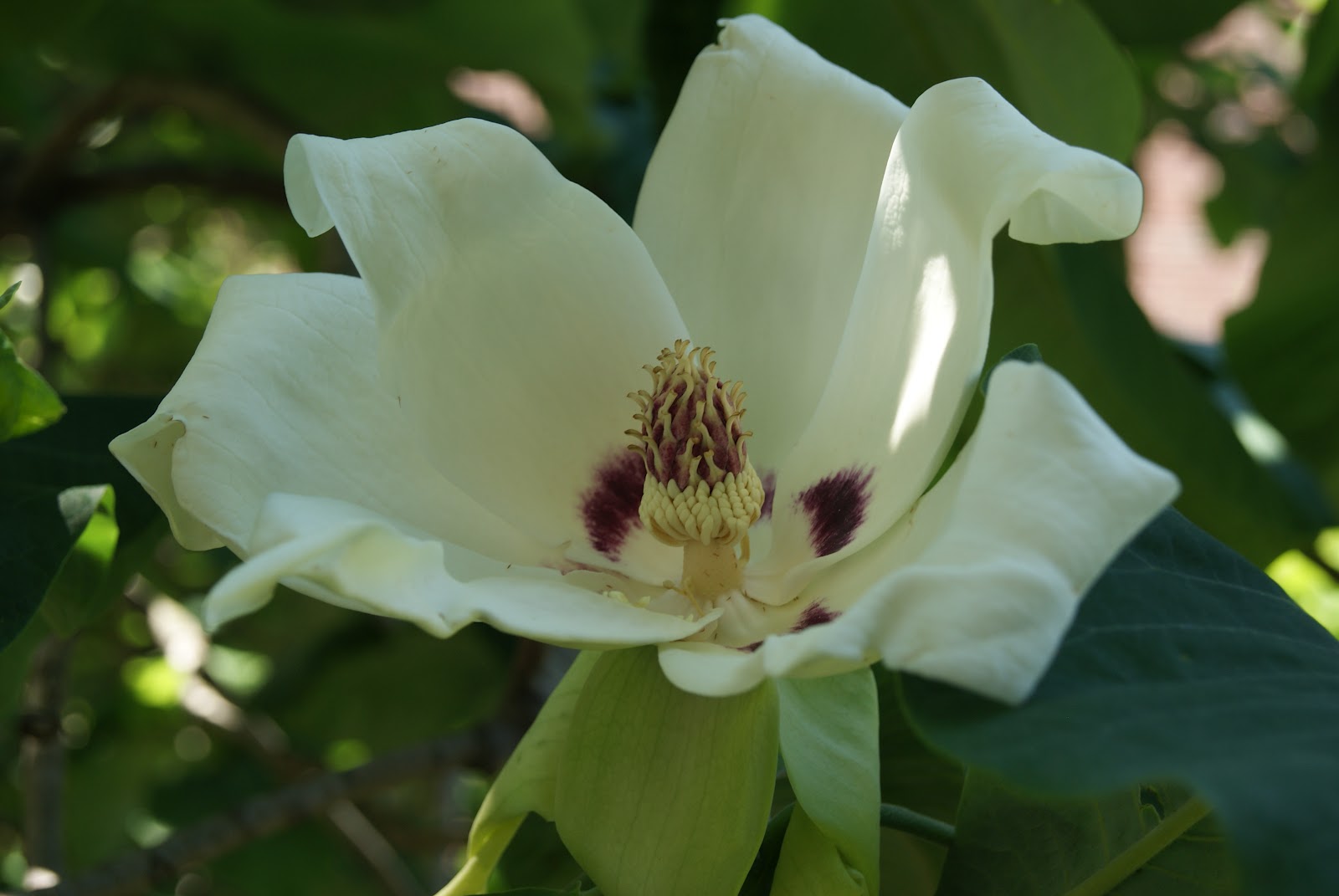
 The Bigleaf Magnolia (Magnolia macrophylla) is a deciduous tree fairly similar to the above two species, but distinct enough that I credit it as being the tree that got me interested in botany and horticulture. When first seeing the plant, with its large undulating leaves spanning almost the entire length of my arm, as well as the huge flower buds that would soon open to reveal proportionally huge flowers, I found myself almost instantly questioning and challenging my perceptions on what a tree was. I'd always had a bit of an interest in plants, trees in particular, but it wasn't I saw this one that I really made it a point to learn more. I'd soon realize there was a lot more to plants than "the green things that don't move", and gain an appreciation for biodiversity which would alter my career and educational plans from that point on. Embarrassingly enough, I actually don't have all that many photos of it to share. I do however have a nice closeup of the closely related species Magnolia ashei (Ashe Magnolia), which is very similar though has a distinct purple blush towards the base of the tepals which the Bigleaf Magnolia lacks. The Ashe Magnolia is also interestingly endemic to (only found within) the Florida Panhandle, though it grows quite well when planted as far north as Boston.