Showing posts with label magnolia. Show all posts

Wednesday, June 6, 2012

Our native Magnolias

I had planned to go into much greater detail about Magnolias this spring, but found myself a bit caught off guard by our strange weather, which seemed to cause spring to not only come quick, but to also progress at a much faster rate than I would have anticipated. Most of our native Magnolias however flower in late spring or early summer, so were a bit protected from this. I'm probably not going to do a big entry like this for a while as gathering all the pictures I need takes quite a bit of time, but for now, we'll continue with one of my favorite genera, Magnolia.

Southern Magnolia (Magnolia grandiflora)
The Southern Magnolia (Magnolia grandiflora) is probably what would come to most people's mind when thinking of a native member of the genus. During my time living in New England I can only think of two or three which I saw growing at all, both in heavily protected locations and one of which had a noticeable yellow hue to the foliage throughout the winter months. It's for this reason I was a bit surprised to see the species flowering last week here in Delaware. Even though I'm now living in the range where these can be grown quite a bit more easily, I had still envisioned them as a species which flowered a bit later in the summer. Apparently, this is not the case. Still, it is an interesting plant not only for the large, white flowers, but also for its thick, leathery, evergreen foliage which on some plants has a heavy, brown pubescence to the underside. One of the hardiest cultivars, 'Bracken's Brown Beauty', has such a heavy pubescence the undersides of the leaves appear a dark brown in color, and is probably one of the best choices for those feeling courageous and wanting to grow the species in New England (I've also seen 'Edith Bogue' performing quite well).


Sweetbay Magnolia (Magnolia virginiana)
Up in New England, its much more common to see the Sweetbay Magnolia (Magnolia virginiana) in the landscape, though there is one wild population known in Massachusetts. It's considered to be "Semi-evergreen", as many leaves will often remain on the plant through the winter months. I've seen this vary immensely from tree to tree. The vast majority of plants I witnessed in New England would have few if any leaves present on the tree by February, probably 5% leaf cover at maximum, though there was one plant in Boston I remember being surprised to still have something like 75% cover even after a cold winter. When I moved to Delaware, as expected many of the trees held more leaves, and though the winter here was very mild this year, one plant seemed to still have nearly 90% leaf cover in the coldest week of January.
The flowers are quite nice as well, and though they are noticeably a bit smaller than that of the other Magnolias I'm describing here, they do tend to bloom for a longer period of time as far as I can tell. I've heard of their fragrance being described as somewhat lemony.

Cucumbertree (Magnolia acuminata)

The Cucumbertree is different from the above two species first as it is fully deciduous and thus holds no foliage over the winter months, and second, is one of only a few magnolias which is not considered to have a particularly showy flower. Personally, I find it to be quite interesting even if admittedly less attractive due to the waxy appearance and greyish, maybe blue-green color to the outside of the petals (defintley more green in the photo above). I'll actually often refer to it as my favorite Magnolia in order to be a contrarian, which is probably not much of a surprise to anyone who knows me personally. Anyway, the Cucumbertree is also quite important in Magnolia breeding as it is the source of the yellow color found in the flowers of many magnolia hybrids, such as 'Elizabeth', 'Butterflies', and 'Yellow Bird'. The name Cucumbertree is in reference to the fruit, an aggregate of multiple follicles which resembles a cucumber, especially before it has fully ripened. Other Magnolias also have an aggregate fruit, but it generally tends to resemble a cone-like structure, often seen on the ground with several red follicles emerging from the black rotting "cone".


Umbrella Magnolia (Magnolia tripetala)
Auriculate leaf base of Magnolia fraseri
And for comparison, Magnolia tripetala,
which lacks this base
The next two species, the Umbrella Magnolia (Magnolia tripetala) and the Fraser Magnolia (Magnolia fraseri) are very similar species and are often confused in the trade, but can be reliably distinguished from each other so long as you know what you're looking for. The base of the leaf blade of the Fraser Magnolia is auriculate, meaning it has two earlobe-like projections which extend towards the petiole (the stalk holding the leaf blade). The leaf of the Umbrella Magnolia has no such projections, instead narrowing to a point on either side of the blade. Both these trees flower quite nicely, with the Fraser Magnolia often having a flower which stands upright for a long period of time, whereas the Umbrella Magnolia has a flower which many find to have a rather disagreeable fragrance.


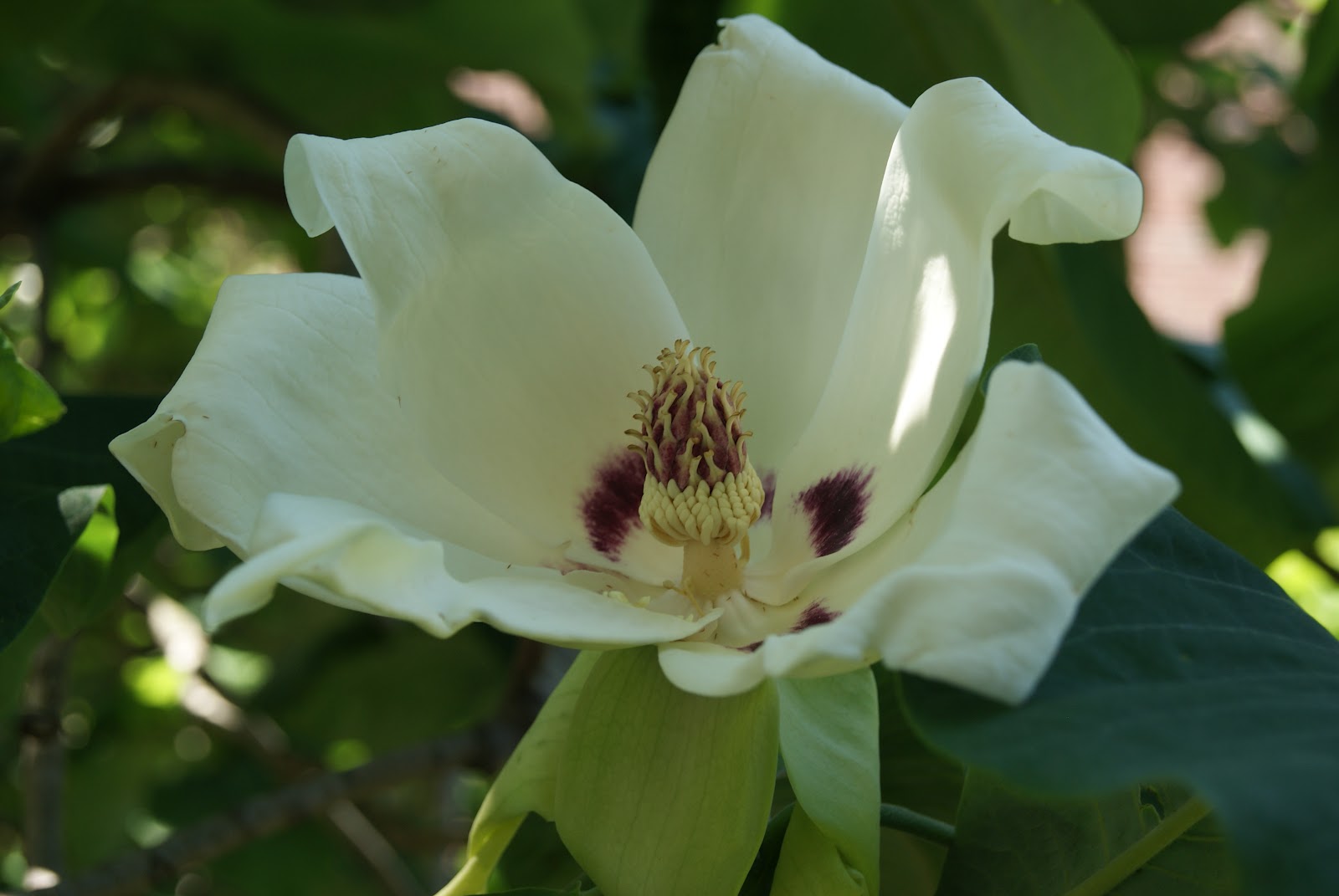
The Bigleaf Magnolia (Magnolia macrophylla) is a deciduous tree fairly similar to the above two species, but distinct enough that I credit it as being the tree that got me interested in botany and horticulture. When first seeing the plant, with its large undulating leaves spanning almost the entire length of my arm, as well as the huge flower buds that would soon open to reveal proportionally huge flowers, I found myself almost instantly questioning and challenging my perceptions on what a tree was. I'd always had a bit of an interest in plants, trees in particular, but it wasn't I saw this one that I really made it a point to learn more. I'd soon realize there was a lot more to plants than "the green things that don't move", and gain an appreciation for biodiversity which would alter my career and educational plans from that point on. Embarrassingly enough, I actually don't have all that many photos of it to share. I do however have a nice closeup of the closely related species Magnolia ashei (Ashe Magnolia), which is very similar though has a distinct purple blush towards the base of the tepals which the Bigleaf Magnolia lacks. The Ashe Magnolia is also interestingly endemic to (only found within) the Florida Panhandle, though it grows quite well when planted as far north as Boston.
Ashe's Magnolia (Magnolia ashei)
On a personal note, I'm finding myself wrapping up my first year of graduate school and still really enjoying the experience. I'm heading deep into doing my thesis research over the summer which looks to involve quite a bit of time in the library as well as some lab work, but I plan to still find some time to wander out into the gardens as well and hopefully get some photos of a few more plants that pique my interest.

Monday, April 16, 2012

a few photos from my trip to NC

It's been a good two weeks since I got back from my trip to North Carolina, and I still have a few photos that I'm looking to share despite that I don't have time right now to really do a full writeup like I usually do.
We're definitely getting into the later parts of the spring semester now and I'm starting to feel a bit of a time crunch. I'm finding that as a new graduate student I'm constantly having to juggle four rather sizeable projects: taking classes, teaching classes, doing research for my thesis, and working for the botanic gardens. I found it a bit difficult to prioritize it all at first: the teaching and botanic garden work is what pays for me to be here, but in the end its doing well with the coursework and putting together a good thesis that will allow me to stay here and receive a degree. The way I usually end up weighing it out is to make sure I can keep all the balls in the air but be absolutely certain that the coursework one never touches the ground... easier said than done though, especially in some of the courses based more on cumulative memorization where you're responsible for a large amount of material by the end. Ironically doing this blog over the winter actually helped me out a bit when taking Plant Taxonomy this semester as I had a little bit of a jump start when it came to flower parts and fruit types and such. Still a little ways to go though, the carpel concept still seems to be eluding me...

Bletilla striata
Anyway, spring has been weird here, as it has just about anywhere else. The hot temperatures pushed the early to mid spring Magnolias out about a month earlier than I was anticipating seeing them, and then the temperatures dropped a bit slowing everything down. Unfortunately, some of the mid-late spring Magnolias I was hoping to cover here seem to be some of those plants that got caught in the middle, getting close to their peak just about at the same time the cold snap hit. I've been keeping an eye on them, but there's still a few too many dead flowers on the plant at any given time to really get a good photo. Now with another heat wave who knows what will happen. I did however see the Magnolia tripetala and Calycanthus floridus blooming which I'm hoping to get a few photos of so maybe I'll find some time to talk about those in the future.

Anyway, in no particular order (well, in the order I took them), here are a few photos from my trip to the JC Raulston Arboretum and elsewhere in Raleigh, NC.

A Crepe Myrtle,  or Lagerstroemia. Despite that these are frequently dismissed by horticulturists as "Crap Myrtles' due to their ubiquitous use in the Southeastern US, I still consider myself a New Englander for the time being and think of this as a 5' max shrub, so seeing this champion at the JC Raulston Arboretum was quite impressive.
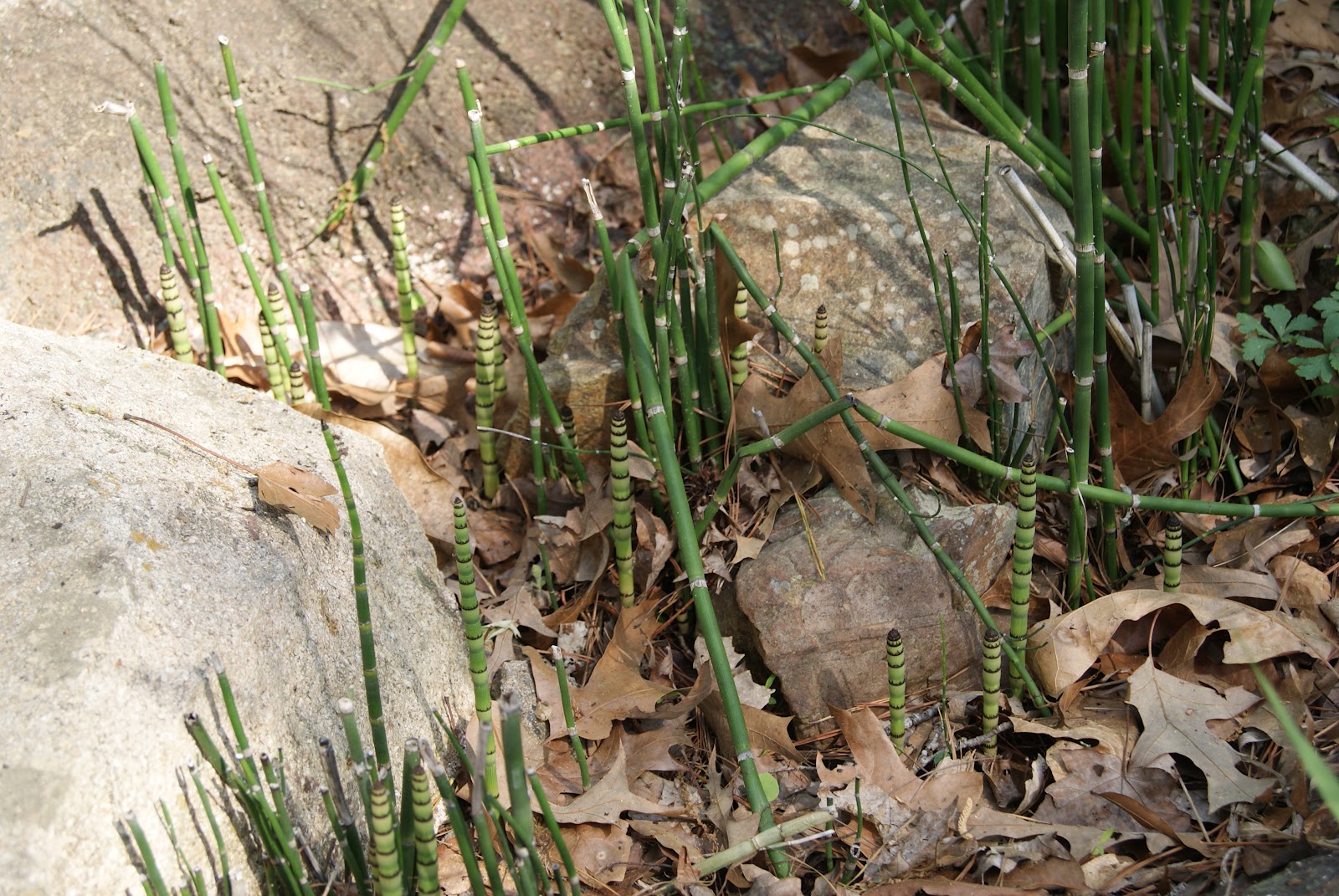
This is Equisetum. I think it's a real neat plant and am likely to blog about it again later so this won't be the last time you see this photo. This is actually from the North Carolina Botanic Gardens in Chapel Hill, NC.
Styrax, the plants I'm doing my M.S. Thesis on, were not in bloom, so this is an image of a close relative, Sinojackia rehderiana (Rehder Jacktree). A pretty nice tree I think, though it apparently has some disease issues.
Magnolia liliiflora, one of the parents of the Saucer Magnolia... now just need to get a picture of the other one...
A saw a ton of Redbuds (Cercis canadensis) on the drive down to NC, particularly in the parts of I 95 in Southern Virginia . The JC Raulston Arboretum has the national collection of Redbuds, but most of them were actually finishing their bloom by the time I was down there. Redbuds are also known for flowering prolifically on the stem, as this plant is (not sure if it is C. canadensis or another species)
An obligatory Magnolia photo. This is 'Coral Lake'
This is a stand of Loblolly Pines (Pinus taeda), at a State Park I drove through right before heading back up to NC. I like this photo as when looking from top to bottom, you can really see how much of a scar a paved road leaves on an ecosystem.
Well, those are my featured photos... figured I'd get them up before they're too far out of date. Hope to be talking about Magnolias and Calycanthus soon!

Saturday, March 24, 2012

Magnolia kobus, stellata, and x loebneri (with a little bit about hybrid naming)

In my last post about the Saucer Magnolia, I mentioned there was another popular magnolia also blooming now: the Star Magnolia or Magnolia stellata. It's very closely related to the Kobus Magnolia (Magnolia kobus), to the point where some taxonomists consider it the Star Magnolia to be a variety of it (Magnolia kobus var. stellata). There is also a hybrid of the Kobus and Star Magnolia, the Loebner Magnolia, Magnolia x loebneri.

Magnolia x loebneri 'Merril'
As I mentioned last time, the Saucer Magnolia (Magnolia x soulangeana) is a hybrid of two asian Magnolias: The combination of the Yulan Magnolia (Magnolia denudata) as the seed parent, and the Lily Magnolia (Magnolia liliiflora) as the pollen parent. So where does the "x soulangeana" part of the name come from? Some hybrids, particularly those which are either naturally occurring or common in the trade with many named cultivars, will be formally named and described by botanists. This allows the Saucer Magnolia to have a slightly less complicated botanic name, as were it not described, the plant would be referred to by using a hybrid formula (Magnolia denudata x liliiflora), which gets to be a bit unwieldy.

Rarely, you might actually see described intergeneric hybrids (pollen and seed plants of two different genera), such as x Sorbaronia alpina, a hybrid between Sorbus aria (Whitebeam) and Aronia arbutifolia (Red Chokecherry).  In this case, since the hybrid is between two species of two different genera as opposed to between two species of the same genus, the "X" proceeds the name of the genus, which in this case is an amalgam of its two parent genera.

A graft where the stem (above) is noticeable outgrowing the
rootstock (below). From Wikipedia's article on Grafting. 
Even more rarely, you might see a name resembling the above, but proceed by a "+", as in +Crataegomespilus. This indicates a graft chimera between Crataegus (Hawthorn) and Mespilus (Medlar). Graft chimeras are weird, there's no way around it, and two my knowledge there are only a scant few known to exist.
For those who may be unaware, grafting is basically when you take the stem of one plant, and attach it to the rootstock of another plant. This is commonly done with fruit trees: you don't necessarily want to let your apple trees get up to 40 feet tall since that makes it a lot harder to harvest the fruit. By taking the stem of the apple tree you like the fruit of and grafting it to the rootstock of a smaller growing apple tree, you can control the adult height of the plant. I unfortunately don't have any of my own photos of the process to share, but there are many available at Wikipedia's article on Grafting.
The graft in the photo above is quite clean, but in many cases the rootstock may send up stems of its own as well.

A graft chimera is when the resulting grafted plant has three distinct types of shoots or stems: shoots of the grafted stem, shoots of the rootstock, and shoots which oddly enough have characteristics of both of the plants. These are quite rare, and you're unlikely to come across them, but I think its an interesting example of some of the odd things that plants can do.

Moving back to Magnolias, we'll start out with a straight species...

Kobus Magnolia (Magnolia kobus)
An old, now deceased Kobus Magnolia at the Arnold Arboretum
I've seen the Kobus Magnolia quite frequently in Botanic Gardens, but less frequently in the residential landscape. I suspect it's displaced in the trade by the Star and Loebner Magnolias, as those tend to flower a bit more heavily as well as at a younger age. I find the flowers of the Kobus Magnolia to be a bit larger in general however.

The species is native to Japan mostly, though is also found in South Korea. The name "Kobus" is apparently dervied from the Japanese common name for the species, Kobushi. I have no idea what kobushi means.

Embarrassingly enough, I don't currently have a picture of the Magnolia stellata (Star Magnolia), though I did heavily photograph the one at the Rose Kennedy Greenway during my two years there. Here's a link to a 4/25/11 article I wrote on the species while working there, which includes a good photograph of the plant framed by One International Place in the background.

The Star Magnolia is actually fairly rare in the wild, currently found only in Honshu, Japan. It has long been in cultivation however, with many popular cultivars such as 'Centennial', ' Royal Star', and 'Waterlily'. The name stellata refers to the shape of the flowers, which resemble stars.


Magnolia x loebneri 'Leonard Messel'
The Loebner Magnolia (Magnolia x loebneri or Magnolia kobus var. loebneri) is a hybrid of the Star and Kobus Magnolias. Like the Saucer Magnolia, its not a natural hybrid, as the native ranges of these two species (or varieties) don't overlap, so they were never really introduced to each other without human help. The hybrid is named for a german breeder, M. Loebner, who made the first hybrids and introduced the species into cultivation.

Magnolia x loebneri 'Ballerina' 
Still cultivated today, It seems to be about as popular as the Star Magnolia, though it has its own niche in the landscape as it tends to grow about 10' higher, owing to its heritage from the Kobus Magnolia. Fortunately, it still flowers at quite a young age/

There are quite a few popular cultivars of the Loebner Magnolia, 'Leonard Messel' (Pictured above) is arguably the most so, owning to its distinct flowers which have petals (well, we should probably use the term "tepals", but more on that later) that are pink on the outside and white on the inside.

'Merril', also pictured above, tends to flower at a younger age than other Loebner Magnolias and is also quite a popular cultivar.

Though I photographed entirely white cultivars save for 'Leonard Messel', pink is not an uncommon color for this species, and many cultivars will have at least some pink, and sometimes flowers which are pink when first emerging from the bud but mature to white. I'm not sure I've ever seen a cultivar with a pure pink flower though.

Magnolia x loebneri 'Ballerina' 
I haven't seen 'Ballerina' quite as much as the other two, but it's a bit smaller than 'Merril', and as is evident by comparing the two photos, it has far more petals (...or tepals) per flower. I'm honestly not quite sure which of the two I prefer... is more petals preferable or does it just make the flower look more crowded? Maybe I'm just waiting for a Star Magnolia that really wows me and I haven't come across one yet. These are probably my least favorite of the spring-flowering magnolias... I prefer the rarer Magnolia salicifolia to it as they seem to flower for a bit longer, albiet never explode into bloom quite as much as the Star and Loebner Magnolias. However, I still enjoy watching the Star Magnolias come into bloom this time of year, and they are probably the first spring-flowering tree I get excited about.

Still have a few more magnolias to talk about, and at some point I'll go into the characteristics of the Magnolia Family (as well as this mysterious "tepal" term I kept trying to drop).

Tuesday, March 20, 2012

Saucer Magnolias in march

Saucer Magnolia (Magnolia x soulangeana) outside of
Worrilow Hall at the University of Delaware
In the month when we would generally be expecting to see snowdrops and the earliest few daffodils flowering, we're instead greeted by cherries and magnolias in full bloom. The whole situation has me feeling a bit uneasy... maybe it's just that I grew up in New England, but I'm still fearing a late frost or snowstorm will decimate this premature spring landscape. A quick look at the extended forecast however shows no such thing, so maybe we're safe.
Were I still a full-time horticulturist, I'm sure I'd be feeling a further sense of panic as my busy season would be starting up far before I had planned, but now as a full-time student, maybe I can afford to take a relatively worry-free approach to the early arrival of the spring flora, and in particular my personal favorite, the magnolias.

My interest in the genus began the first time I saw Magnolia macrophylla, a native summer-flowering species I'll discuss on this blog a bit later. I didn't pay as much attention to the spring flowering species until doing a year-round internship at the Polly Hill Arboretum, where one of my projects involved recording the flowering status of the magnolia collection on a weekly basis.


I was surprised to see the Magnolias burst into full flower so quickly this year, as I usually notice a solid gap between the time when the Star Magnolias (Magnolia stellata) start, and when the Saucer Magnolias join them. Though Magnolia biondii entered bloom about when expected, I recall seeing a few Star Magnolias breaking bud, then when I checked again a few days later a good half of the UD Magnolia collection was approaching full bloom.
Though I certainly enjoy the Star Magnolias, I find their flowers a bit flimsy in comparison to those species flowering later in the season, with the Saucer Magnolia one of the first to begin the trend. Maybe it's the size of the flowers (sometimes reaching 10" in diameter), or the way the thickness of the petals give the flower a more "solid" appearance than much of what else is in bloom this time of year.

The Saucer Magnolia is actually a hybrid between two asian species, the Yulan Magnolia (Magnolia denudata) and the Lily Magnolia (Magnolia liliiflora). The Yulan Magnolia was long cultivated in asia for its pure white flowers, and the Lily Magnolia is a shrubbier species with pink flowers. The offspring has found a home in our landscape, as is probably one of the two more commonly planted and easily recognizable of the spring-flowering Magnolias (the other being the Star Magnolia).

Magnolia x soulangeana 'Sundew'

All the above images are of the standard hybrid, but I also witnessed the cultivar 'Sundew', which based on what I just read at the Magnolia Society's Cultivar Checklist, is an older cultivar which may possibly have some relationship to Magnolia cambellii. It also appears to be somewhat uncommon, or at least I would assume so based on it's notable absence from Dirr's Manual of Woody Landscape Plants and Callaway's The World of Magnolias.

Though Saucer Magnolias often struggle in less mild springs, with an early warm snap followed by a late frost almost certain to kill off the emerging flowers, when it does flower successfully, I find its firm, upright flowers a sign that spring has arrived, albeit surprisingly early in this case.

Took many pictures of magnolias on Saturday (with many more to come next week) so probably plenty more magnolia posts to come over the next few days. Next time I'll probably talk about Magnolia kobus and Magnolia x loebneri. Until then there's always plenty about Magnolias on the Magnolia Society's facebook page.

Sunday, February 26, 2012

Magnolia biondii

So I'm taking a brief break from my planned adaptation/living planet themed entries to show off a few more photos... I did make it to Longwood's Orchid Show last week, and am hoping for another visit shortly so there's a post on orchids in the works, but in the meantime I have a few photos on Google+ available here if you can't wait...

Magnolia biondii
Anyway, If I haven't mentioned it earlier, Magnolias are probably my favorite genus of tree. In fact, I credit the Bigleaf Magnolia (Magnolia macrophylla) with being the plant that got me interested in horticulture, botany, and eventually Botanic Garden Curation. I'll focus on that one later this summer when it is in bloom, but suffice to say it truly challenged my perceptions of what a tree could be, and furthered my appreciation for botanical biodiversity to the extent where I became passionate about sharing these realizations with others.

Framed by a fruiting holly for reference

As far as I know, this is the first Magnolia to bloom, and with them being a tree already known for early spring flowering that should say something. Seeing Magnolia biondii begin to push out flowers in late February or early March is quite regular, though whether or not it ends up getting away with jumping the gun in this fashion varies from year to year. More often than not, winter is not quite ready to depart yet, and another cold snap causes the tree to abandon  the process.

I'd seen the tree begin to break bud here at UDBG after a string of fifty degree days (which coincided with my first ride down DE Route 9 for the season), but when I saw the temperature was going to hit 60 last week I really began to take note. I've never really seen the flower do much more than break bud during my time living in New England, but given my move a little further down south as well as an unconditionally warm winter, I was in a pretty good position to see this flower fully open.

About the best I could do for a closeup... Tree is about 25' tall so
I couldn't zoom in on anything too close... this is cropped
It's definitely a smaller flower than you'd see on later spring magnolias such as the Star or Saucer Magnolia, and the tree as a whole is certainly less prolific in terms of flowering, though it's hard to say for sure if this is characteristic of the species or if this specimen is just struggling. Regardless, I think the flower itself is still interesting. Though not as showy, it is easily recognizable as that of a magnolia, probably closer to Magnolia cylindrica than anything else I've seen. Most noticeably, the pink coloration towards the base is deep, distinct, and prominent.

Maybe it's just that I've been watching Living Planet and am thinking in terms of adaptations, but I'm now puzzled by the early flowering time of this species. Is there in fact a pollinator which operates at these lower temperatures? Or is this an example of Magnolia biondii behaving differently in terms in cultivation versus the way it does in the wild? Unfortunately I don't have a book to reference at the moment as I left my copy of The World of Magnolias at school for a side project I'm working on, but I'll look into it tomorrow and see if I can come up with a better guess.

I'm not sure how much more these flowers will open, but with the weather forecast claiming 60 again tomorrow, I plan on having my camera with me most of the week. I've even spotted a few buds closer to eye level so this might not be the last we see of this tree this year.

Hopefully within the week I'll have the Orchid entry planned out... it's probably going to be a long one but I'm real happy with the photos so far so I'm thinking it will be a good one.