Showing posts with label orchids. Show all posts

Monday, April 16, 2012

a few photos from my trip to NC

It's been a good two weeks since I got back from my trip to North Carolina, and I still have a few photos that I'm looking to share despite that I don't have time right now to really do a full writeup like I usually do.
We're definitely getting into the later parts of the spring semester now and I'm starting to feel a bit of a time crunch. I'm finding that as a new graduate student I'm constantly having to juggle four rather sizeable projects: taking classes, teaching classes, doing research for my thesis, and working for the botanic gardens. I found it a bit difficult to prioritize it all at first: the teaching and botanic garden work is what pays for me to be here, but in the end its doing well with the coursework and putting together a good thesis that will allow me to stay here and receive a degree. The way I usually end up weighing it out is to make sure I can keep all the balls in the air but be absolutely certain that the coursework one never touches the ground... easier said than done though, especially in some of the courses based more on cumulative memorization where you're responsible for a large amount of material by the end. Ironically doing this blog over the winter actually helped me out a bit when taking Plant Taxonomy this semester as I had a little bit of a jump start when it came to flower parts and fruit types and such. Still a little ways to go though, the carpel concept still seems to be eluding me...

Bletilla striata
Anyway, spring has been weird here, as it has just about anywhere else. The hot temperatures pushed the early to mid spring Magnolias out about a month earlier than I was anticipating seeing them, and then the temperatures dropped a bit slowing everything down. Unfortunately, some of the mid-late spring Magnolias I was hoping to cover here seem to be some of those plants that got caught in the middle, getting close to their peak just about at the same time the cold snap hit. I've been keeping an eye on them, but there's still a few too many dead flowers on the plant at any given time to really get a good photo. Now with another heat wave who knows what will happen. I did however see the Magnolia tripetala and Calycanthus floridus blooming which I'm hoping to get a few photos of so maybe I'll find some time to talk about those in the future.

Anyway, in no particular order (well, in the order I took them), here are a few photos from my trip to the JC Raulston Arboretum and elsewhere in Raleigh, NC.

A Crepe Myrtle,  or Lagerstroemia. Despite that these are frequently dismissed by horticulturists as "Crap Myrtles' due to their ubiquitous use in the Southeastern US, I still consider myself a New Englander for the time being and think of this as a 5' max shrub, so seeing this champion at the JC Raulston Arboretum was quite impressive.
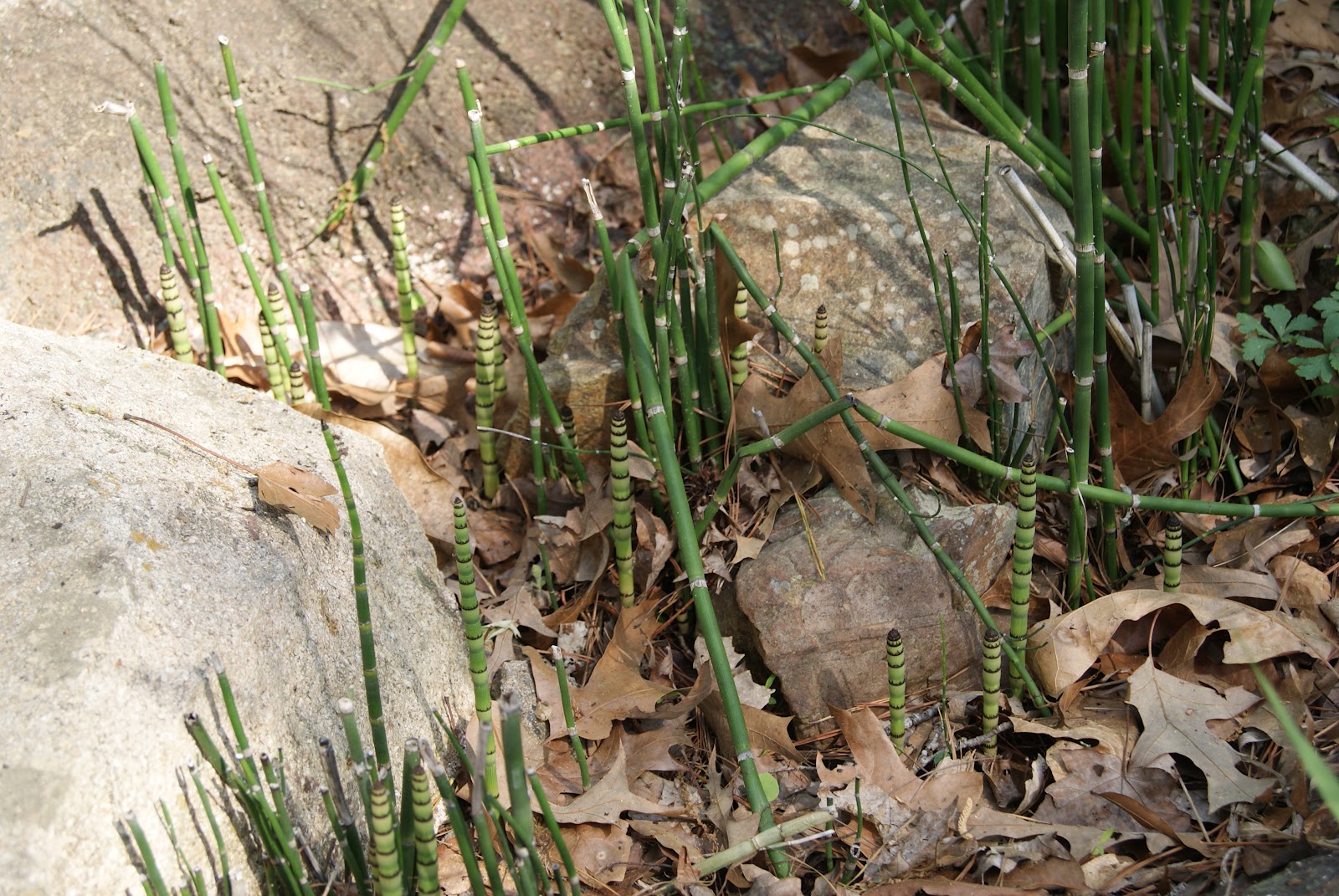
This is Equisetum. I think it's a real neat plant and am likely to blog about it again later so this won't be the last time you see this photo. This is actually from the North Carolina Botanic Gardens in Chapel Hill, NC.
Styrax, the plants I'm doing my M.S. Thesis on, were not in bloom, so this is an image of a close relative, Sinojackia rehderiana (Rehder Jacktree). A pretty nice tree I think, though it apparently has some disease issues.
Magnolia liliiflora, one of the parents of the Saucer Magnolia... now just need to get a picture of the other one...
A saw a ton of Redbuds (Cercis canadensis) on the drive down to NC, particularly in the parts of I 95 in Southern Virginia . The JC Raulston Arboretum has the national collection of Redbuds, but most of them were actually finishing their bloom by the time I was down there. Redbuds are also known for flowering prolifically on the stem, as this plant is (not sure if it is C. canadensis or another species)
An obligatory Magnolia photo. This is 'Coral Lake'
This is a stand of Loblolly Pines (Pinus taeda), at a State Park I drove through right before heading back up to NC. I like this photo as when looking from top to bottom, you can really see how much of a scar a paved road leaves on an ecosystem.
Well, those are my featured photos... figured I'd get them up before they're too far out of date. Hope to be talking about Magnolias and Calycanthus soon!

Sunday, March 4, 2012

The Jungle: Orchids and their velamen

Wall of Orchids at Longwood Gardens, displaying some of the diversity
The orchid family is one of the most diverse groups of flowering plants, essentially in a tie for first with the asters. They can roughly be split into two groups based on their growth habit: the terrestrial, or those that live in the ground, and the epiphytic: those that live aerially, often planting themselves in the crotches of branches of canopy trees within the jungle.

Paphiopedilum, a terrestrial orchid
The Jungle was the second biome featured in the Living Planet, and one I found particularly interesting as it depicts a compound ecosystem consisting of three distinct "stacked" habitats where an organism might live: the forest floor, the trunks of trees, or the canopy of these trees. The epiphytic orchids reside in this second layer: not planted in the ground as we tend to think of plants as always being, and not tall enough to have unrestricted access to the sun.

Due to their choice of habitat, the Orchids can't rely on ground water, so must instead draw water from the air of the humid environment around them. In order to accomplish this, they have modified roots, some of which are actually aerial, white or silvery-grey in color, and spongy in texture.  This color and texture results from a covering of velamen, actually the modified epidermis of the root which helps to absorb and hold in water.

An Aerial root on a Phalaenopsis I've acquired
These specialized roots are what often serve as a source of difficulty when many try to grow these in their homes. They assume that due to their native habitat the plant needs a lot of water, and overwater the plant resulting in these roots rotting. They do like this humid environment (some orchids actually wiliting as soon as they're removed from 70-80% humidity), but can't stand having their "feet wet", so to speak.

Probably the most common type of orchid grown, and probably the easiest as well, is the Phalaenopsis, or the Moth Orchid. The common name comes from the floweres, but I feel saying they resemble moths is an understatement. When I first had the opportunity to look at one of these flowers close up, I was taken aback by how accurate this mimicry seems to be, with the center of the flower so approximating the head and eyes of the insect.

Eye to eye, or rather eye column to with a Phalaenopsis
Aggregate of several Phalaenopsis at Longwood Gardens
Last time my Phalaenopsis flowered, I was curious enough to lift up the "moth face" (which is considered the "column" of the flower), curious as to what was underneath. Immediately upon lifting it up, two anther sacs popped out from underneath, exposing the reproductive parts of the flower. This stigma is further below in this structure. The pollinator would inadvertently lift up the "face" or cap of the column when inside the flower, then be covered with the pollen from the anthers, which would be deposited into the stigma when they do the same with another Phalaenopsis flower.

I wish I could show some detailed photos of the column, but couldn't this time around as I took all these at Longwood Gardens. Merkle's Orchids however has a great rundown on orchid flower morphology.

A hybrid containing Cattleya, another popular though more difficult orchid

I'm hoping to get a few more orchids for myself at some point. Planning on trying to grow a Paphiopedilum as well as a Bulbophyllum which I think I'll need to grow in a hanging basket. I was actually going to buy them last year but held off when I learned I'd be moving to Delaware, so I'll see if I can find the money this time around.

A little later this week we're going to revisit Tree ID, and learn how to identify a few Pines.